
Apple's Most Health-Capable Watch Yet
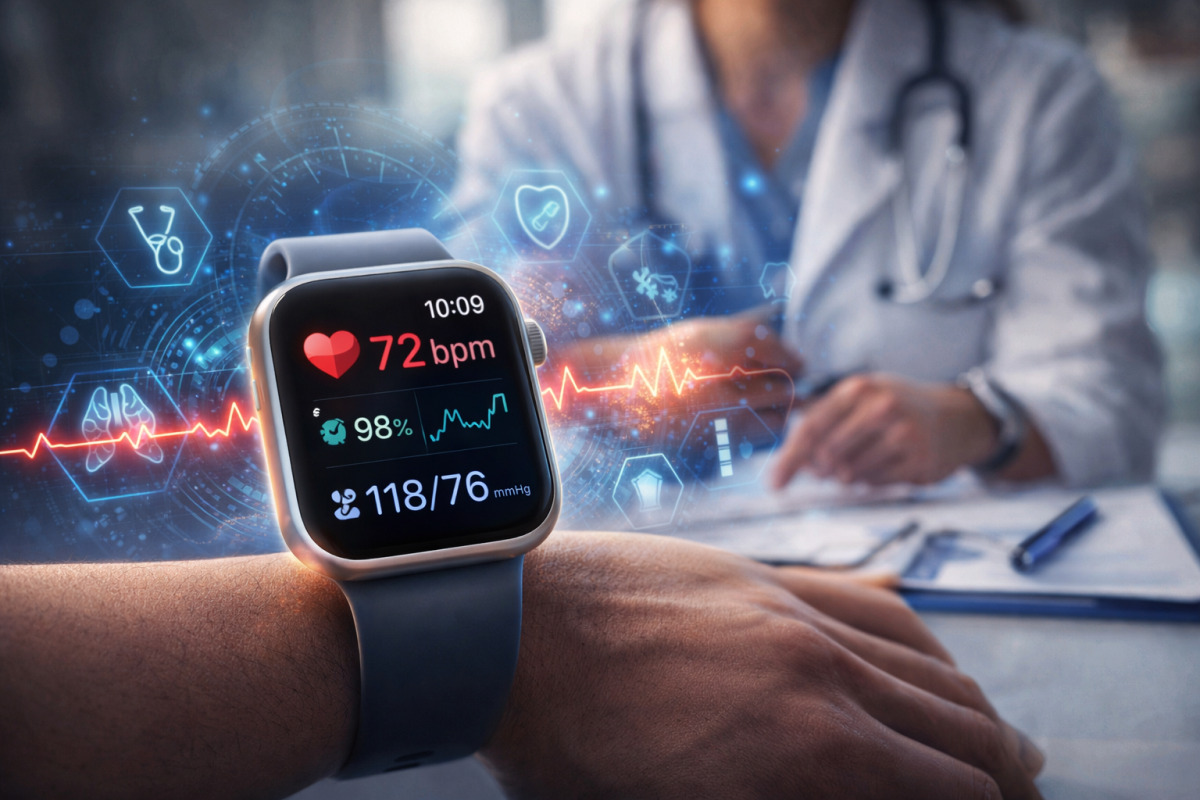
The Apple Watch Series 10, launched in September 2024, represents Apple's most ambitious health push to date - and it arrives at a moment when the line between consumer wearable and medical device has never been thinner. The Series 10 is the thinnest Apple Watch ever made, yet packs a sensor suite that would have seemed implausible in a wrist device a decade ago: ECG, blood oxygen monitoring, skin temperature sensing, sleep apnea detection, and a heart rate monitor capable of detecting atrial fibrillation. Every one of these features has received FDA clearance or approval.
Sleep apnea detection - a headline addition in the Series 10 and watchOS 11 - works by monitoring breathing disturbances during sleep using the accelerometer. After 30 days of data collection, the watch provides an assessment of whether your breathing patterns suggest a risk of sleep apnea and prompts you to consult a doctor. Clinical data showed strong sensitivity for detecting moderate-to-severe apnea events, and in the months since launch, physicians report that the feature has prompted meaningful numbers of patients to seek diagnosis for a condition that frequently goes undetected for years.
The Blood Glucose Question
The most-anticipated Apple Watch health feature - non-invasive blood glucose monitoring - remains on the horizon rather than in the box. Apple has been working on the technology, internally codenamed E5, for over a decade. A Bloomberg report in 2023 confirmed the project had reached proof-of-concept stage, but miniaturising the hardware to fit inside a watch remains the engineering challenge. Analysts now expect this feature to debut no earlier than 2027, likely in the Apple Watch Series 13. For now, diabetics and those managing blood sugar can pair their Series 10 with third-party CGMs like the Dexcom G7, which connects directly to the watch and delivers real-time glucose readings without a phone nearby.
Mental Health and State of Mind
Perhaps the most thoughtful new feature is State of Mind - a passive mental health tracking tool that uses motion patterns, heart rate variability, sleep quality, and activity data to help users log and understand their emotional state over time. Apple deliberately avoids positioning this as a diagnostic device, and rightly so. But the longitudinal data it generates - patterns across weeks and months - is already proving valuable in clinical research partnerships and for individuals who want a more objective picture of their wellbeing beyond self-reporting.
The Doctor Question
The question of whether wearables can replace physicians is the wrong frame. What Apple Watch Series 10 does exceptionally well is continuous monitoring - 24/7 passive health surveillance that no annual check-up can replicate. A single ECG during a doctor's visit tells you what your heart was doing for 30 seconds. The Watch tells you what it has been doing every day for the past year. That longitudinal record makes every medical appointment more productive and every intervention more timely. The answer to the headline question is no - but it makes your doctor significantly more effective, and it catches things that would otherwise be missed entirely.