
The DJ That Keeps Getting Smarter
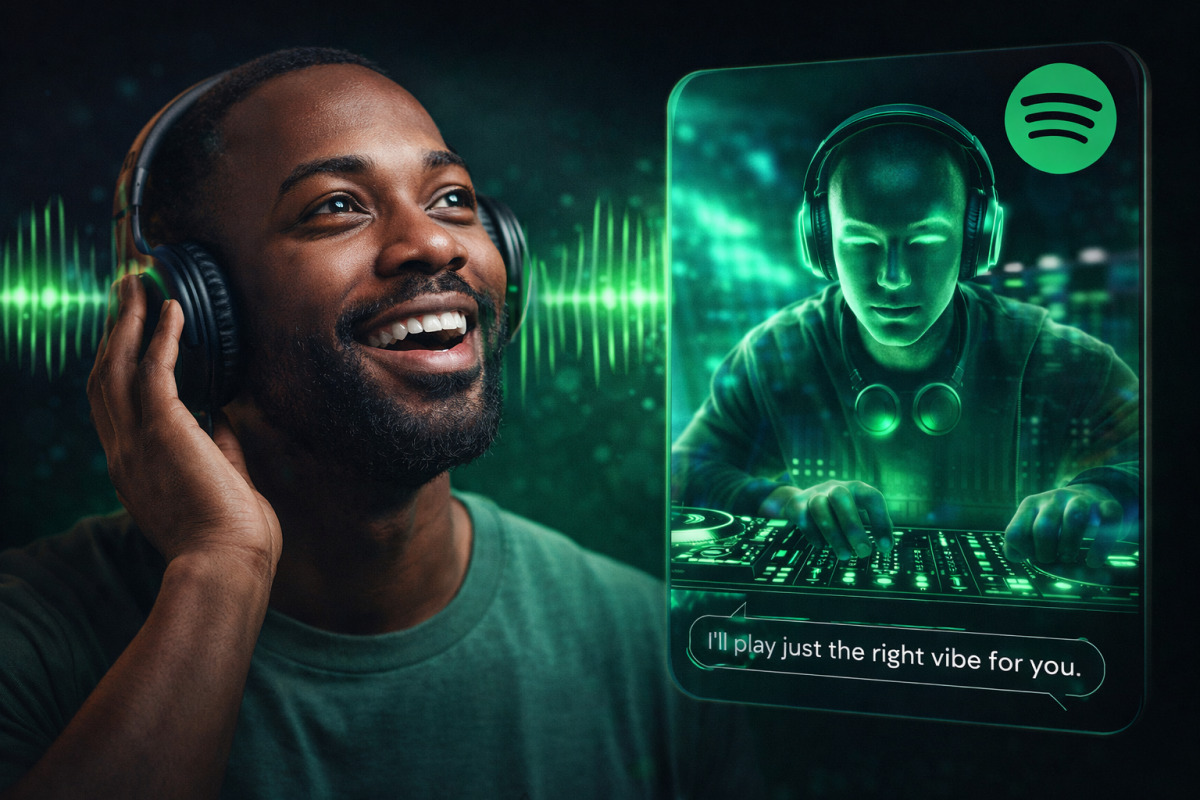
Spotify launched its AI DJ feature in February 2023 - a personalised radio experience with an AI-voiced host modelled on Xavier "X" Jernigan, Spotify's Head of Cultural Partnerships. In the two years since, it has become the platform's most talked-about feature. The original DJ played you music it thought you'd like, with brief commentary between tracks. It worked well enough to build a loyal audience - Spotify reported that DJ engagement "nearly doubled" in the year to May 2025. What has changed since is the ability to interact with it.
Voice requests launched in May 2025, letting Premium users instruct the DJ in real time: "give me something more upbeat," "play some 90s Bollywood," "switch to focus music." In October 2025, Spotify added text requests and Spanish-language support, with DJ Livi handling Spanish-speaking listeners. The cumulative effect is a DJ that feels genuinely responsive - not just a playlist in disguise, but something that adjusts to your actual moment. After 40 hours spent with it across commutes, work sessions, workouts, and evenings, it is without qualification the best music discovery experience I have used.
The Uncanny Valley of Curation
The underlying intelligence is Spotify's personalisation engine - years of listening history, genre affinity, skip patterns, and time-of-day behaviour - combined with editorial knowledge from Spotify's global music experts, expressed through a generative AI voice. The result is a system that sometimes anticipates what you need before you have articulated it. At 9pm after a long day, it surfaced a 45-minute session of low-tempo Brazilian jazz and ambient electronics I had never consciously searched for, and found profoundly restorative. That kind of accurate emotional inference - from an algorithm - creates a dissonance that is worth sitting with. We are entering an era where software models our inner state better than we narrate it ourselves.
The Discovery Engine
The DJ's most underappreciated function is discovery. In our 40-hour test, it introduced 23 artists we had never heard. We followed 14 of them. That 61% follow-through on new artist introductions is a remarkable result for any recommendation system. Spotify has built the most effective music discovery engine in the industry's history, and the DJ is its most powerful interface - partly because its conversational form makes accepting a new artist feel like taking a recommendation from a knowledgeable friend, rather than clicking an unfamiliar card in a grid.