
A New Industrial Revolution
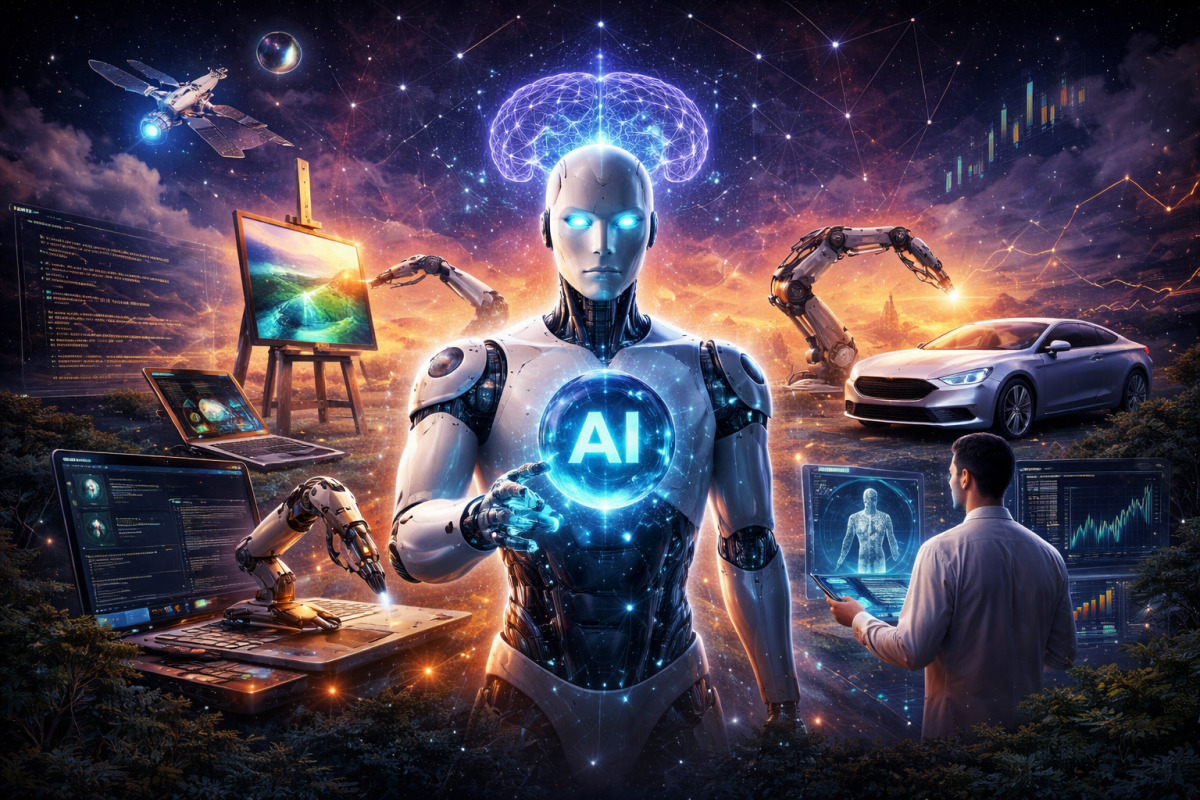
We are living through a technological transformation that economists will one day rank alongside the invention of electricity and the internet. Artificial intelligence is not a single technology - it is a general-purpose tool that amplifies human capability across every domain it touches.
In 2025, AI-assisted diagnostics detected early-stage cancers in clinical trials with 94% accuracy - outperforming specialist radiologists in controlled studies. In agriculture, computer vision systems are helping smallholder farmers in Maharashtra identify crop diseases days before visible symptoms appear. In law, AI review tools are processing contracts in minutes that previously required weeks of paralegal time.
The Industries Being Transformed
Healthcare leads the transformation. Drug discovery timelines have collapsed from a decade to 18 months in some therapeutic areas, powered by AI systems that can model protein interactions at atomic resolution. AlphaFold 3 alone has unlocked targets for diseases that had no viable drug candidates for decades.
Financial services are equally transformed. Algorithmic trading now accounts for over 70% of global equity volume. Fraud detection systems powered by deep learning catch patterns imperceptible to human analysts. Credit scoring models now incorporate thousands of variables, extending access to capital for underbanked populations.
The Challenges Ahead
The acceleration is not without friction. Regulatory frameworks are struggling to keep pace with capability advances. The European Union's AI Act is already facing calls for revision just months after implementation. In the United States, a patchwork of sector-specific guidelines has created compliance complexity that burdens smaller innovators disproportionately.
Perhaps more pressing is the question of workforce displacement. The World Economic Forum's 2025 Future of Jobs Report projected that 92 million jobs will be displaced by 2030 - but also that 170 million new roles will be created, resulting in a net gain of approximately 78 million jobs globally. The net positive masks a painful transition for workers in routine cognitive roles: paralegal assistants, basic data analysts, customer service agents, and entry-level programmers.
India's Strategic Moment
For India, the AI revolution presents a rare strategic opportunity. With a young, technically educated workforce and a massive domestic market, India is uniquely positioned to be both a builder and deployer of AI systems. Initiatives like IndiaAI and the government's ₹10,300 crore AI Mission signal serious intent.
The next five years will determine which nations become AI exporters and which become AI importers. The decisions made today - in research labs, boardrooms, and legislatures - will shape the global balance of technological power for a generation.