

A Genuinely New Kind of AI Tool
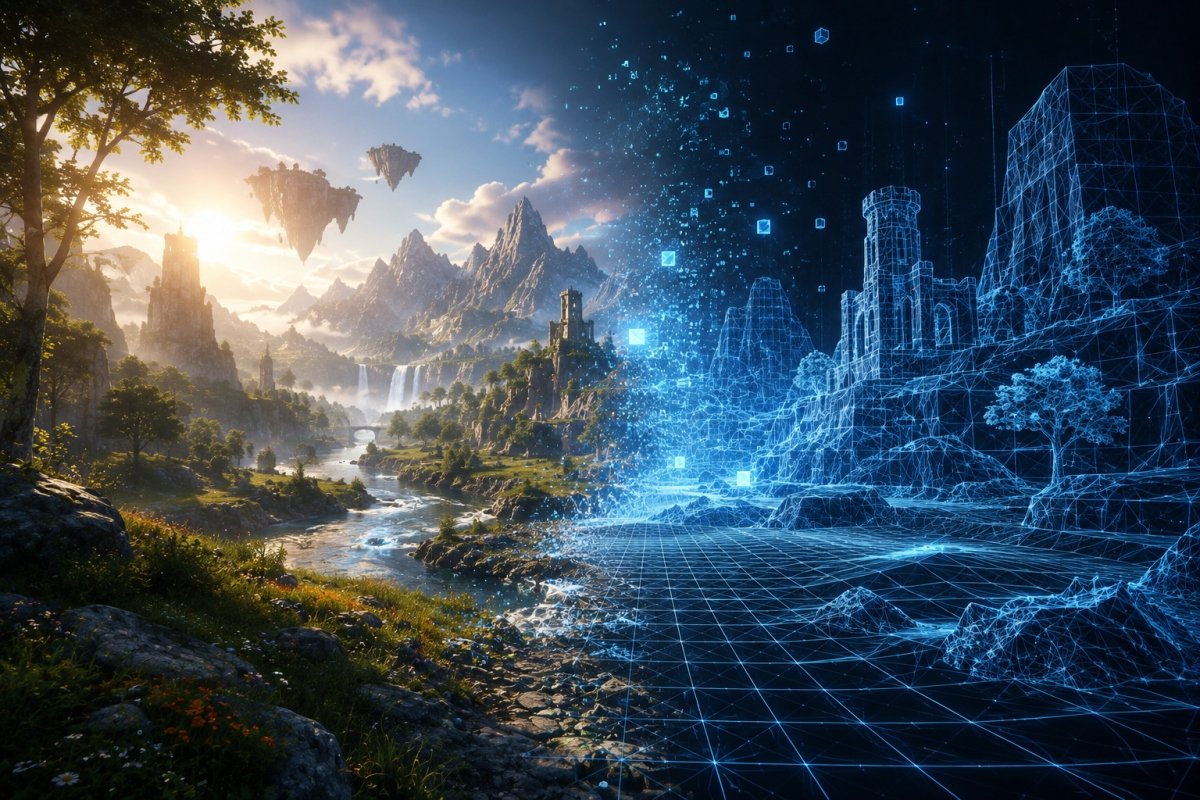
In January 2026, Google DeepMind released Project Genie to the public, built on its Genie 3 "world model." Unlike a video generator that produces a fixed, watch-only clip, Genie generates interactive environments that respond in real time as you move through them - turn a corner and the world materialises from scratch, generated on the fly rather than assembled from pre-built assets. Trained on more than 30,000 hours of gameplay footage, it can turn a text prompt, a sketch, or a photo into an explorable, physics-obeying 3D space at 24 frames per second. It's a genuinely different category of tool from traditional procedural generation, which recombines pre-made pieces according to fixed rules - Genie is generating the world's textures, geometry, and physics dynamically, without a pre-loaded map sitting in memory anywhere.
The Market Reaction Tells Its Own Story
When Genie launched, publicly traded game companies including Unity and Take-Two saw their stock prices dip - a striking, if difficult to fully interpret, signal of how seriously markets are taking the possibility that AI could restructure game development. Whether that reaction was proportionate is genuinely debatable; industry commentators at the time pointed out that Genie's current outputs are simple, short-duration environments, nowhere close to threatening a complex, narrative-driven, quadruple-A production like Grand Theft Auto 6.
The Numbers Behind the Adoption
Beyond headline-grabbing world models, AI has already become standard infrastructure inside game studios. A Google Cloud survey found 90% of game developers now integrate AI into their workflows in some form, and 97% believe generative AI is fundamentally reshaping the industry. The AI-in-gaming market reached $4.54 billion in 2025 and is projected to grow to over $80 billion by 2035. This isn't speculative future technology - for the large majority of working game developers, AI tools are already a normal part of how games get made, whether for concept art, dialogue generation, or asset creation.
The Backlash Is Just as Real as the Adoption
Here's the genuinely balanced part of this story: developer and player sentiment has moved sharply negative even as adoption keeps climbing. The percentage of game industry professionals viewing generative AI negatively jumped from 30% in 2025 to 52% in 2026, and separate research found 85% of gamers hold negative attitudes toward AI in games. The industry has even coined a specific term for the downside - "gameslop" - describing low-effort titles assembled primarily through AI tools with minimal human curation. Analysis of these AI-heavy releases found user review scores running 15-20% lower than traditionally developed titles, with refund rates two to three times higher than the industry average - a fairly direct, measurable signal that players can tell the difference and don't like what they're getting.
Why the Backlash and the Adoption Aren't a Contradiction
Both trends being true at once makes sense once you separate two different uses of the same technology: AI as a tool that helps skilled developers work faster - drafting concept art, generating dialogue variations, prototyping level layouts - versus AI as a wholesale replacement for the creative judgement that makes a game good in the first place. The "gameslop" backlash is overwhelmingly aimed at the second category, while the 90% developer adoption figure reflects the first. Industry analysis increasingly frames the winners of this transition as studios that use AI to amplify an existing creative vision, not ones that use it to skip having one.
Where This Actually Goes
Right now, Project Genie remains capped at roughly 60-second interactive sessions at 720p resolution - a genuine research milestone, not yet a finished creative tool, and DeepMind itself describes it as an "experimental research prototype." Realistic near-term applications look less like "AI generates entire finished games" and more like AI-assisted prototyping, faster iteration on level design, and increasingly sophisticated procedurally-assisted content within games still fundamentally directed by human designers. The technology is advancing quickly and the investment is real, but so is the evidence that players notice, and penalise, games where AI substituted for craft rather than supporting it.